
CNSR-Panel Letter of Intent
For qualification of the Composite Neurochemical Stress-Resilience Biomarker Panel (CNSR-Panel) as a pharmacodynamic biomarker under the FDA Biomarker Qualification Program (BQP), assessed by NeXus AI computational analysis. Single Context of Use: pharmacodynamic characterization of neurochemical response in adult combat veterans with severe post-traumatic stress disorder during Phase 2 clinical evaluation of novel psychiatric drug candidates.
Contents per FDA BQP LOI Outline v 2.0 (2026)
Cover Letter
To: Biomarker Qualification Program Staff
Center for Drug Evaluation and Research (CDER)
U.S. Food and Drug Administration
Email: CDER-BiomarkerQualificationProgram@fda.hhs.gov
From: NeXus Neuroinformatics, Inc.
614 County Highway 325, Hamilton, Alabama 35570
EIN 42-3415697
Wholly owned operating subsidiary of Nexus Concordat, Inc.
Date: [To be inserted on filing, the day the Delaware certificate of incorporation returns.]
Re: Letter of Intent for Qualification of the Composite Neurochemical Stress-Resilience Biomarker Panel (CNSR-Panel) as a pharmacodynamic biomarker, assessed by NeXus AI computational analysis, for combat-veteran post-traumatic stress disorder drug development.
Dear Biomarker Qualification Program Team,
NeXus Neuroinformatics, Inc. respectfully submits this Letter of Intent for qualification of the Composite Neurochemical Stress-Resilience Biomarker Panel (CNSR-Panel) as a composite pharmacodynamic biomarker under the FDA Biomarker Qualification Program. The CNSR-Panel comprises seven peripheral and epigenetic measurements, assessed and scored by NeXus AI computational analysis as the proposed measurement method:
- Plasma cortisol with dexamethasone suppression
- DHEA / cortisol ratio
- High-sensitivity plasma IL-6 (hs-IL-6)
- High-sensitivity plasma CRP (hs-CRP)
- Plasma neuropeptide Y (NPY)
- AIM2 promoter methylation
- FKBP5 intron-7 methylation
The single proposed Context of Use is pharmacodynamic characterization of neurochemical response in adult combat veterans with severe post-traumatic stress disorder during Phase 2 clinical evaluation of novel psychiatric drug candidates. No FDA-qualified pre-clinical pharmacodynamic biomarker panel currently exists for this combat-veteran indication; the proposed CNSR-Panel directly addresses that gap.
The seven constituent biomarkers are each supported by peer-reviewed published evidence in combat-veteran cohorts. The Requester has 162 verified citations on file spanning:
- HPA-axis regulation
- Neuroinflammation
- Neuropeptide-Y resilience
- Sex-steroid endocrinology
- Epigenetic glucocorticoid receptor regulation
Composite scoring and pharmacodynamic interpretation is performed by NeXus AI, a chemistry-conditioned computational interpretation engine that is implemented, operational, and publicly queryable at nexusneurodata.com/cell-demo.html (cardiac-domain reference instance). The psychiatric-domain instance, psych_gen1, is in active training and will provide the load-bearing analytical evidence for the proposed CoU.
NeXus Neuroinformatics, Inc. holds an exclusive license to the underlying patents, currently held by parent organization Nexus Concordat, Inc. (Provisional Patent Applications 63/939,190, 63/962,385, 63/988,485, and 64/034,536).
Per Section 507 of the FD&C Act, the Requester acknowledges that the submission title, Requesting Organization identity, Context of Use, and Drug Development Need framing will become publicly available upon acceptance. The stand-alone Executive Summary required under Section 507 transparency is submitted as a separate PDF file accompanying this LOI. Proprietary architectural detail of the NeXus AI assessment method in Section VII (Analytical Considerations) is provided under request for confidential treatment.
The Requester is prepared to respond to FDA's questions and to present to review staff at FDA's invitation.
Sincerely,
Marjorie McCubbins
Founder and Chief Executive Officer
NeXus Neuroinformatics, Inc.
Attachments: Executive Summary (stand-alone PDF, per Section 507 transparency); Biomarker Qualification Program Letter of Intent organized per FDA BQP LOI Outline v 2.0 (2026); Numbered Reference List.
1. Submission Title
2. Requesting Organization
Name of Organization
NeXus Neuroinformatics, Inc.
Physical Address: 614 County Highway 325, Hamilton, Alabama 35570
Phone: [to insert]
Website: nexusneurodata.com
EIN: 42-3415697
State of Incorporation: Delaware
Parent Organization: Nexus Concordat, Inc. (IP holder, licensor)
Primary Point of Contact
Marjorie McCubbins
Founder and Chief Executive Officer, NeXus Neuroinformatics, Inc.
Address: 614 County Highway 325, Hamilton, Alabama 35570
Phone: [to insert]
Email: [to insert]
Alternate Point of Contact
[To insert. Candidate: Aislinn McCubbins, Chief Operating Officer, Dynamic Hallucination, Inc., or other designated alternate.]
Supporting or Participating Organizations or Individuals
- Robert Michalik, JD, RAC. Regulatory advisor, pro bono.
- Shailee Desai, M.S. Regulatory Affairs candidate, Northeastern University. Design control documentation per 21 CFR 820.30, IEC 62304, IEC 82304.
Note: Nexus Concordat, Inc. is the parent holding company and IP owner. The patent licensing relationship between Nexus Concordat, Inc. and NeXus Neuroinformatics, Inc. is documented under Section 7.9 (Intellectual Property). Nexus Concordat, Inc. is not an operational participant in this submission.
3. Drug Development Need Statement
Per FDA: 200 words maximum target.
Psychiatric drug development faces three compounding problems that no current tool resolves in combination:
- Subjective outcome measurement. Reliance on clinician-rated scales (HAM-D, MADRS, PANSS) with known inter-rater variance.
- Intuition-driven mechanistic modeling. Behavioral state expectations under candidate compounds reasoned from prior literature and clinical intuition during study design, not from quantitative simulation.
- Signal-detection failure at late phase. Phase 2 and 3 psychiatric trials cost industry billions and patients decades. Many failures are signal-detection failures, not efficacy failures.
NeXus AI addresses the modeling and signal-design gap. The tool consumes FDA-recognized chemical and physiologic biomarkers and produces deterministic, literature-grounded predictions of directional behavioral state change under specified pharmacologic perturbations. It enables in-silico screening of trial design decisions before wet-trial commitment:
- Population stratification
- Dose selection
- Endpoint timing
Currently used computational tools in this space fall into three categories, each missing what NeXus AI provides:
- Narrow PK/PD models. Mechanistic but behavior-blind.
- Behavioral state classifiers. Behavior-aware but mechanism-blind.
- General-purpose LLM-based assistants. Neither mechanistic nor reproducible.
[EDIT 2026-06-29 — tightened absolute language ("uniquely" / "no existing") to search-bounded, evidence-citable phrasing]
The summary claim. NeXus AI is a chemistry-conditioned, mechanistically grounded, cryptographically reproducible interpretation engine. Based on the requester's June 2026 review of publicly available BQP and ISTAND records and the peer-reviewed program analysis of accepted submissions through July 2025, no qualified DDT was identified that occupies this analytical layer.
Lead Demonstration Domain: Combat-Veteran PTSD
NeXus Neuroinformatics has selected combat-veteran post-traumatic stress disorder as the lead demonstration domain for the psychiatric Context of Use. The choice is deliberate, supported by four facts:
- Prevalence. Approximately 13 percent of post-9/11 U.S. combat veterans carry a PTSD diagnosis (VA National Center for PTSD, 2022).
- Therapeutic stagnation. Fewer than five new chemical entities have received FDA approval specifically for PTSD between 2000 and 2023; the dominant pharmacotherapies (sertraline, paroxetine) date from the 1990s [82].
- Phase 2 attrition cost. Single failures routinely cost sponsors 50 to 100 million dollars and three to five years of program time.
- Public-sector funding intensity. The Department of Defense and Department of Veterans Affairs together fund approximately 1.2 billion dollars annually in PTSD-related care and research.
The lead-domain choice gives NeXus AI a quantifiable signature target (combat-veteran biomarker distributions are extensively published) and an evidentiary substrate of 162 verified peer-reviewed citations spanning combat-veteran biomarker literature, PTSD mechanistic neurobiology, in silico validation methodology, FDA regulatory format, and CDISC data standards. The full numbered reference list appears at the end of this document. The psychiatric instance, psych_gen1, will demonstrate the COU first in this domain before expansion to civilian-trauma populations on subsequent qualification supplements.
A companion submission, the Composite Neurochemical Stress-Resilience Biomarker Panel (CNSR-Panel), is in pre-LOI consultation with the FDA Biomarker Qualification Program. The CNSR-Panel comprises seven peripheral and epigenetic measurements that the psych_gen1 instance will reproduce, perturb, and reason over:
- Plasma cortisol, with basal value and low-dose (0.5 mg) dexamethasone suppression. Combat-veteran PTSD shows low basal cortisol and enhanced dex hypersuppression in cohorts from Vietnam-era through OEF/OIF [1, 2, 9], with replication across PTSD cohorts [7, 8], large-N Vietnam-era plasma evidence (n = 2,490) [9], and intact adrenal reserve indicating central rather than adrenal dysregulation [3].
- DHEA-to-cortisol ratio, from the same blood draw. Higher DHEA and inverted DHEA/cortisol ratio track combat-veteran PTSD severity and predict treatment response [28, 29].
- High-sensitivity plasma IL-6. Elevated in combat-related PTSD independent of depression [15], with meta-analytic confirmation across 20 studies [14], low-grade systemic confirmation [16], and inflammation-fear-circuit reviews [22].
- High-sensitivity plasma CRP. Pre-deployment CRP prospectively predicts post-deployment PTSD symptoms in active-duty Marines (n ≈ 2,600, Marine Resiliency Study) [13], with PTSD-discordant Vietnam-era twin replication (459 pairs) [18], community-sample CRP elevation [19], and cytokine review evidence [22].
- Plasma NPY. Low CSF NPY in OEF/OIF PTSD [23], higher plasma NPY tracking recovery and active coping [24], Special Forces resilience characterized by faster stress-induced NPY recovery [84], and blunted NPY response to yohimbine challenge in combat PTSD [27].
- AIM2 promoter methylation, peripheral whole-blood DNA. Mediates the PTSD-to-inflammation link in post-9/11 veterans (n = 286) [37, 38].
- FKBP5 intron-7 methylation, peripheral whole-blood DNA. Allele-specific FKBP5 demethylation mediates childhood-trauma-by-genotype risk [33], predicts prolonged-exposure response in combat veterans [34, 35], and tracks MBSR response in veterans [36]; FKBP5 SNPs modulate GR function and the gene-by-trauma interaction risk for PTSD [67].
The CNSR-Panel qualifies the inputs; NeXus AI qualifies the interpretation logic that operates on them.
4. Biomarker Information and Interpretation
Per FDA BQP LOI Outline v 2.0 (2026). High-level description; detailed analytical and clinical descriptions in Sections VII and VIII.
A. Biomarker Description
Name: Composite Neurochemical Stress-Resilience Biomarker Panel (CNSR-Panel).
Type per BEST Glossary: Composite (multi-component) pharmacodynamic biomarker.
Constituent measurements (seven):
- Plasma cortisol — basal and post-low-dose (0.5 mg) dexamethasone suppression
- Plasma DHEA / cortisol ratio
- High-sensitivity plasma interleukin-6 (hs-IL-6)
- High-sensitivity plasma C-reactive protein (hs-CRP)
- Plasma neuropeptide Y (NPY)
- AIM2 gene promoter methylation
- FKBP5 intron-7 methylation
Measurement Method: Standard clinical immunoassay (ELISA) platforms for plasma proteomic constituents; bisulfite-treated DNA sequencing or pyrosequencing for methylation constituents. Composite panel interpretation and pharmacodynamic response scoring is performed by NeXus AI, a chemistry-conditioned computational interpretation engine described in Section VII (Analytical Considerations).
Composite nature: The seven-constituent panel captures three biologically distinct response axes in combat-veteran PTSD pathophysiology — (1) HPA-axis regulation and stress adaptation (cortisol/DST, DHEA/cortisol ratio); (2) systemic neuroinflammatory tone (hs-IL-6, hs-CRP); (3) neuropeptide resilience signaling and epigenetic glucocorticoid-receptor regulation (NPY, AIM2 methylation, FKBP5 methylation).
B. Biomarker Interpretation and Utility
The CNSR-Panel is intended to inform drug development decisions in the proposed Context of Use by characterizing combat-veteran PTSD pharmacodynamic response to candidate psychiatric drug interventions. Composite panel shifts under therapeutic perturbation are interpreted as evidence of biological engagement of the targeted neurochemical pathway. The biomarker serves as a pharmacodynamic response biomarker per BEST taxonomy, supporting:
- Pharmacodynamic stratification of trial participants by baseline panel signature
- Dose-range justification via exposure-response modeling against panel shifts
- Trial-enrichment criteria definition for Phase 1 and Phase 2 trial designs
- Mechanism-of-action signal detection in early-phase combat-veteran PTSD trials
Interpretive thresholds. Specific cutoff points and composite scoring thresholds are described in the Analytical Considerations section (VII) and refined in the planned Qualification Plan submission.
Advantages over current approach. No FDA-qualified pre-clinical pharmacodynamic biomarker panel currently exists for combat-veteran PTSD. Sponsors evaluating candidate compounds for this indication rely on rodent fear-conditioning models with limited translational fidelity to combat-trauma neurobiology, or construct ad-hoc per-trial biomarker measurement strategies that lack cross-trial comparability. A qualified CNSR-Panel directly addresses this gap.
Limitations. The CNSR-Panel is not proposed for individual patient diagnosis, individual patient treatment selection, stand-alone efficacy claims, or use outside the combat-veteran PTSD drug development setting.
C. Supporting Evidence
Each CNSR-Panel constituent is supported by peer-reviewed published evidence in combat-veteran cohorts. Strongest treatment-response evidence exists for plasma cortisol/DST, DHEA/cortisol ratio, and plasma NPY in combat-veteran intervention studies. Inflammatory constituents (hs-IL-6, hs-CRP) are supported by meta-analytic evidence of pro-inflammatory tone in combat-PTSD across multiple service eras. Epigenetic constituents (AIM2 promoter methylation, FKBP5 intron-7 methylation) are supported by emerging veteran-cohort epigenome-wide association data. The Requester has curated and annotated 162 verified peer-reviewed citations on file supporting the clinical relevance of the panel constituents in combat-veteran PTSD; full bibliography in Section X References.
5. Context of Use Statement
Per FDA: 250 words. Single COU only. COU must address a specified drug development use.
The CNSR-Panel is proposed for qualification under a single Context of Use:
UPDATED 2026-06-29 Upgraded to BQP-template-compliant CoU: names biomarker explicitly, names BEST category (pharmacodynamic biomarker), names assessment method (NeXus AI), names target population (adult combat veterans with severe PTSD), names study type (Phase 2 evaluation of novel psychiatric drug candidates). ~445 characters — under FDA portal 500-character limit.
The qualified tool would be used by drug development sponsors during the pre-clinical and Phase 1 to Phase 3 design stages of psychiatric pharmaceutical development. Specific drug development uses within the COU include:
- Simulating expected directional behavioral state response to candidate compounds and dose ranges before trial commitment
- Generating mechanistic hypotheses for unexpected behavioral signals observed in pre-clinical or early-phase data
- Supporting study design decisions including endpoint selection, measurement timing, and population stratification
- Identifying mechanistically plausible patient subpopulations expected to show differential directional response to a candidate
Scope boundaries. NeXus AI is bounded by what it explicitly is NOT:
- NOT a patient-level diagnostic or treatment recommendation
- NOT a predictor of the magnitude of human clinical response
- NOT a replacement for human clinical assessment or the judgment of clinical trial investigators
The COU is strictly drug development tooling: helping sponsors design better trials by reasoning quantitatively about expected directional behavior under perturbation, with reproducible computational output.
Use outside this Context of Use is explicitly out of scope:
- Clinical decision support
- Individual patient outcome prediction
- Post-market diagnostic use
Lead-domain worked example. For combat-veteran PTSD, the sponsor workflow is:
- Sponsor evaluates a glucocorticoid receptor modulator (cf. mifepristone pilot in combat PTSD [10], hydrocortisone augmentation of prolonged exposure in OEF/OIF veterans [4]).
- Sponsor submits the candidate compound's mechanism, expected receptor occupancy, and expected CNSR-Panel perturbation profile.
- NeXus AI returns directional predictions for: fear extinction recall (cf. amygdala-vmPFC-hippocampal extinction literature [57, 58]), sleep architecture (REM density, slow-wave proportion), startle reactivity, and HPA-axis recovery kinetics under the proposed dose range, conditioned on combat-veteran baseline chemistry.
- Sponsor pre-registers these predictions.
- Sponsor designs endpoints and timing matched to the predicted directional curves.
- Sponsor stratifies the enrolled cohort by predicted differential response.
- Sponsor evaluates trial signal against the pre-registered predictions.
Generalization. The same workflow applies to other combat-veteran PTSD mechanisms:
6. Drug Development Use
NeXus AI changes the current paradigm of psychiatric trial design from intuition-driven mechanistic reasoning to reproducible computational mechanistic reasoning.
Current paradigm (without NeXus AI)
The current workflow is sequential, intuition-driven, and reconstructive when things go wrong:
- Sponsor identifies candidate compound with mechanism of interest.
- Sponsor consults internal pharmacology and clinical teams.
- Behavioral state expectations under the compound are reasoned from prior literature, animal model data, and clinical intuition.
- Trial design (dose, population, endpoint, timing) is set on the basis of this reasoning.
- Trial runs.
- If signal fails to emerge, root cause analysis is forensic, slow, and often inconclusive.
Proposed paradigm (with NeXus AI)
The proposed workflow is pre-registered, mechanistic, and diagnostic when signal misses:
- Sponsor submits compound profile (mechanism, expected receptor occupancy, expected biomarker perturbation) to NeXus AI.
- NeXus AI returns deterministic directional predictions for behavioral state variables across the proposed dose range, conditioned on the chemistry profile.
- Sponsor uses these predictions to:
- Stratify expected responders versus non-responders mechanistically
- Choose endpoints and measurement timing matched to predicted directional response
- Identify population subgroups expected to show stronger or weaker directional signal
- Pre-register predictions before trial start, creating an a-priori test of mechanism
- Trial runs against pre-registered predictions.
Two possible outcomes:
- Signal matches. Mechanistic story is strengthened.
- Signal misses. Prediction-versus-observation divergence becomes a diagnostic for which part of the model (compound, dose, design) failed.
Decision tree
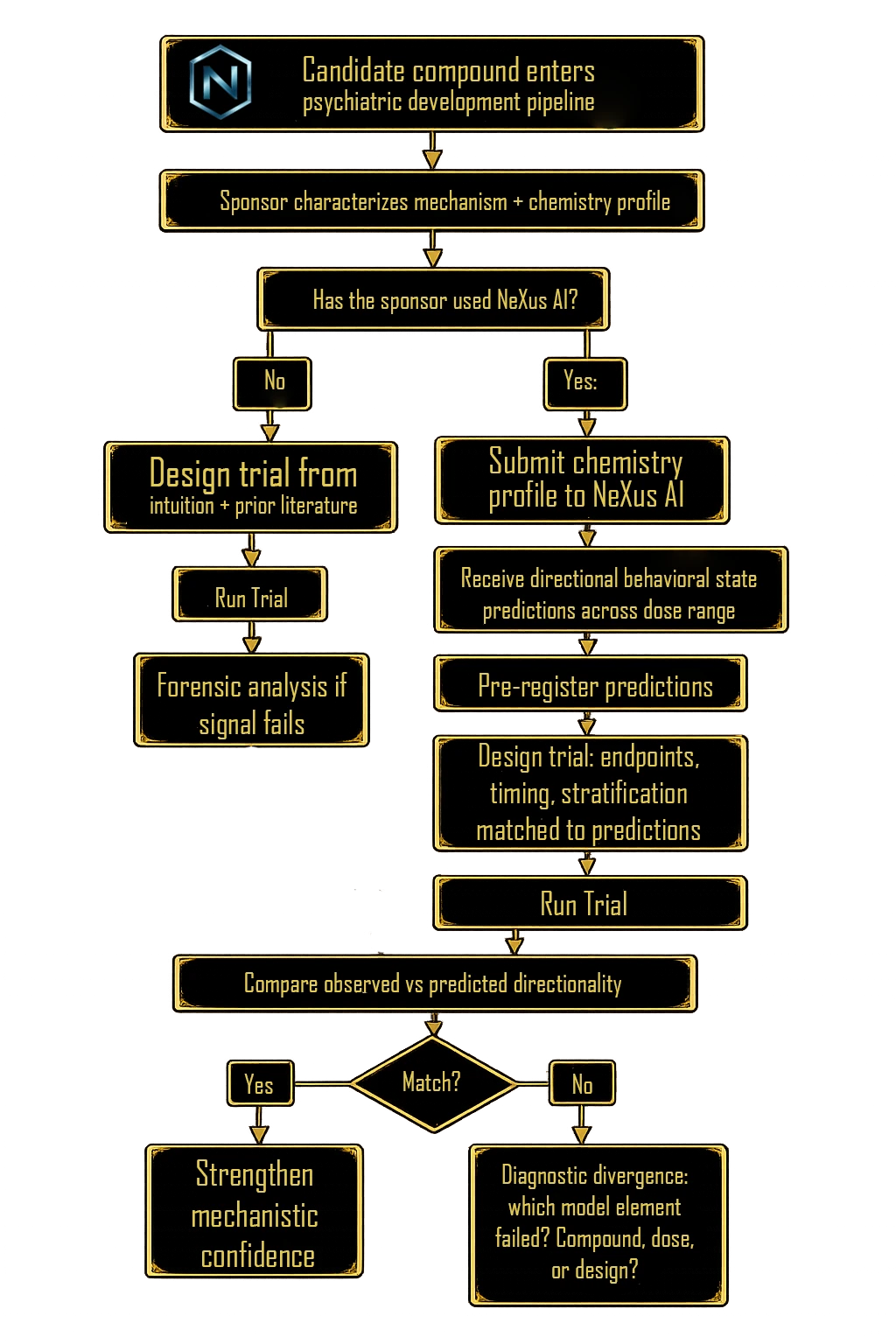
The regulatory outcome that changes: trial design decisions become defensible against reproducible computational predictions made before the trial began, rather than defensible only against post-hoc rationalization.
7. Technical Description
Per FDA: 5 pages plus references. Includes clinical and analytical validity, or plans to establish validity.
7.1 Architectural overview
NeXus AI is a chemistry-conditioned transformer architecture coupled to a biologically grounded interpretation cascade. The realized cardiac-domain instance, cardiac_gen3, is structured as:
- 32-million-parameter chemistry-conditioned transformer
- 34-head Hodgkin-Huxley cascade arranged in four biological tiers:
- 8 amino acid heads
- 6 precursor heads
- 8 neurotransmitter heads
- 12 brain region heads
- Each head implements voting and pharmacokinetic neurochemical decay over a fixed set of neurochemicals
The eight modeled neurochemicals, each with documented decay constants drawn from pharmacology literature:
- Dopamine
- Norepinephrine
- Serotonin
- Gamma-aminobutyric acid (GABA)
- Oxytocin
- Cortisol
- Endorphins
- Acetylcholine
The psychiatric-domain instance, psych_gen1, currently in training, applies the same architectural pattern with a psychiatric-domain training corpus and a psychiatric-domain decoding head. The architectural cascade, the chemistry conditioning, the pharmacokinetic decay logic, and the literature grounding are shared.
7.2 Inputs
NeXus AI consumes FDA-recognized chemical and physiologic biomarkers as inputs. None of these are novel biomarkers requiring qualification. They include:
- Cortisol concentration
- Drug serum levels
- Heart rate variability
- Sleep architecture metrics (sleep onset latency, REM density, slow-wave sleep proportion)
- Inflammatory panel values (C-reactive protein, IL-6, TNF-alpha)
Summary. The interpretation logic operating over these inputs is the subject of qualification, not the inputs themselves.
7.3 Outputs
NeXus AI outputs deterministic directional predictions for psychiatric behavioral state variables under a specified pharmacologic or physiologic perturbation.
What outputs ARE:
- Directional
- Probabilistic per state variable
- Suitable for sponsor reasoning about expected directional trial response
What outputs ARE NOT:
- NOT patient-level diagnoses
- NOT magnitude predictions
- NOT treatment recommendations
7.4 Operating characteristics
Three operating characteristics define how the tool behaves in production:
- Determinism and reproducibility. Outputs are reproducible across runs given identical inputs and identical model weights. Cardiac_gen3 has demonstrated SHA-256 freeze-invariance across 5,000-step Mixture-of-Experts training runs. The model artifact carries a cryptographic signature against a publicly verifiable cell registry. Recipients of NeXus AI output can independently verify which model artifact produced any specific prediction.
- Inference latency. Cardiac_gen3 inference latency in current production is approximately 3 to 8 seconds per query, observed on a single NVIDIA RTX A5000 (24 GB VRAM) on the public live demo at nexusneurodata.com/cell-demo.html. Latency for psych_gen1 is expected to be in the same envelope given identical architectural scale.
- Public live verifiability. The cardiac_gen3 instance is available for public query at nexusneurodata.com/cell-demo.html, rate-limited per IP. FDA reviewers may observe live model behavior and SHA-verify the model artifact against the public registry at any time.
7.5 Realized uses in drug development (current)
Cardiac_gen3 is in beta deployment today. NeXus Neuroinformatics generates anonymized cardiac consult reports from cardiac_gen3 output for clinician review. A sample consult is available at nexusneurodata.com/sample-consult.html.
The consult format illustrates two things:
- Cross-domain correlation NeXus AI produces:
- Metabolic chemistry
- Electrocardiogram
- Medication history
- Cryptographic provenance trail that accompanies each output
7.6 Realized uses in drug development (proposed under this COU)
The psychiatric-domain instance, psych_gen1, will provide:
- Pre-registered directional behavioral state predictions under specified pharmacologic perturbations (mechanism, chemistry profile, and dose)
- Mechanistic hypothesis generation for unexpected pre-clinical or early-phase behavioral signals
- Population stratification recommendations for psychiatric trials based on predicted differential directional response
- Endpoint and measurement-timing recommendations matched to predicted directional response curves
7.7 Clinical and analytical validity
Analytical validity. Established on three points:
- Cardiac_gen3 has demonstrated freeze-invariance under SHA-256 verification across the full 5,000-step training run
- Outputs are deterministic given identical model weights and identical inputs
- Reproducibility across operator, machine, and fresh-build conditions is on the qualification roadmap and will be addressed in the Qualification Plan
Clinical validity. Clinical validity for the psychiatric COU is the load-bearing element of the qualification effort and the subject of the proposed validation roadmap:
| Layer | What it establishes | Status |
|---|---|---|
| 1. Architectural reproducibility | Outputs deterministic. Freeze invariant under SHA verification. | Established. Cardiac freeze SHA across 5,000 step MoE runs. |
| 2. Input defensibility | Inputs are FDA-recognized biomarkers. | Established. Regulatory fact. |
| 3. Interpretation logic literature grounding | Chemistry-behavior mappings cite primary literature under a 10-PMID-per-mapping rule. | Established. 1.4 GB targeted PubMed pull on disk. |
| 4. Construct validity (synthetic vs published) | psych_gen1 synthetic combat-veteran cohorts reproduce published marginal distributions of the seven CNSR-Panel measurements within Pearson r ≥ 0.80 against weighted-summary statistics aggregated from the 162-citation bibliography. | In active development. psych_gen1. |
| 5. Predictive validity (synthetic vs held-out real) | psych_gen1 synthetic cohort distributions concord with held-out real combat-veteran cohorts on PCL-5 distributions, CAPS-5 cluster prevalences, and CNSR-Panel marker correlations. Pass criteria: Cohen's d < 0.2 on key marginals, KS distance < 0.1, AUROC ≥ 0.75 for trained-on-synthetic / tested-on-real classifier. Comparator cohorts: ENIGMA-PGC PTSD Consortium (n = 1,868; 794 PTSD) [41], and VA NCPTSD Registry subject to data-use agreement. | Validation plan drafted. ASME V&V40 nine-step framework [88, 100]. |
| 6. Adversarial and edge-case stress test | Tool handles low-prevalence and high-consequence events: lithium toxicity, serotonin syndrome, withdrawal psychosis, naltrexone-precipitated opioid withdrawal. | Proposed for Qualification Plan. |
| 7. Independent reproducibility | Different operator, different machine, fresh build, identical SHA-256 model artifact, same outputs to deterministic precision. | Proposed for Qualification Plan. |
The Requester proposes that Layers 1 through 3 establish BQP submission plausibility today, that Layer 4 is the load-bearing demonstration accompanying the Qualification Plan submission, that Layer 5 follows under data-use agreement with the comparator cohort owners, and that Layers 6 and 7 are the qualification roadmap deliverables completed under the Qualification Plan.
7.8 Epistemic scope statement
What NeXus AI IS NOT:
- NOT evidence that the model predicts individual human patient outcomes
What NeXus AI IS:
- A Drug Development Tool whose interpretation logic behaves reproducibly
- A Drug Development Tool whose interpretation logic concords with literature-bounded mechanistic expectations across controlled perturbations
What the qualification effort IS: A demonstration of computational mechanistic plausibility under reproducible conditions, not a demonstration of patient-level clinical prediction.
7.9 Intellectual property
The underlying methodology is the subject of four pending U.S. provisional patent applications, held by parent Nexus Concordat, Inc., and exclusively licensed to NeXus Neuroinformatics, Inc. in the pharmaceutical and clinical research field of use:
- 63/939,190. Substrate-Independent Memory Weighting Architecture (pharmacokinetic decay applied to behavioral state representation).
- 63/962,385. Neurochemical Language Model (multi-head cascade architecture conditioned on neurochemical state).
- 63/988,485. AETHER: Adaptive Endocrine Transformer Heads with Emotional Regulation (multi-axis endocrine voting heads with hormone-conditioned regulation, including astrocyte-network governance outside the language-model context window).
- 64/034,536. Scyla: Biologically-Native Programming Language (substrate compiler exposing biology-native opcodes for cell, cascade, and plasticity operations).
Patent text is available for confidential review by FDA reviewers under appropriate confidentiality terms.
[EDIT 2026-06-29 — flipped "future" ISTAND framing to "concurrent" filing; the two LOIs are now parallel cross-references]
7.10 Concurrent ISTAND submission for the NeXus AI interpretation engine
This Letter of Intent qualifies the CNSR-Panel as a composite pharmacodynamic biomarker under the Biomarker Qualification Program, with NeXus AI as the assessment method described in Section VII Analytical Considerations.
Concurrently, the Requester is filing a separate Letter of Intent under the Innovative Science and Technology Approaches for New Drugs (ISTAND) Pilot Program to qualify NeXus AI as a novel computational Drug Development Tool in its own right. That submission addresses NeXus AI as the chemistry-conditioned interpretation engine independent of the specific biomarker panel it measures.
Clean separation between the two qualifications:
- This BQP submission: qualifies the CNSR-Panel as a composite pharmacodynamic biomarker for combat-veteran PTSD drug development
- Concurrent ISTAND submission: qualifies NeXus AI as the computational interpretation methodology in its own right, applicable to additional biomarker panels and clinical contexts beyond combat-veteran PTSD
Summary. The two submissions are complementary, not duplicative. BQP qualifies the biomarker; ISTAND qualifies the tool that tests it. The Requester respectfully requests coordinated review where the analytical and clinical considerations overlap, and is prepared to provide consolidated technical material to both review teams.
8. Previous Qualification Interactions and Other Approvals
Per FDA BQP LOI Outline v 2.0 (2026). Prior interactions with FDA Centers (CDER, CBER, CDRH), Letters of Support, Critical Path Innovation Meetings, prior qualifications, and equivalent ex-U.S. interactions.
Prior FDA interactions: None. NeXus Neuroinformatics, Inc. has had no prior or concurrent regulatory interactions with FDA regarding the CNSR-Panel or NeXus AI as the assessment method.
Prior ex-U.S. regulator interactions: None with any of:
- EMA (European Medicines Agency)
- PMDA (Pharmaceuticals and Medical Devices Agency, Japan)
- MHRA (Medicines and Healthcare products Regulatory Agency, UK)
- Health Canada
- TGA (Therapeutic Goods Administration, Australia)
Public comment submitted to FDA Town Hall on General Wellness Policy for Low Risk Devices (February 11, 2026):
- Nexus Concordat, Inc. (parent holding company; founder M. McCubbins) submitted three substantive policy questions to the CDRH Digital Health Center of Excellence (digitalhealth@fda.hhs.gov) prior to the Town Hall. The questions addressed (a) classification of deterministic computational neurochemical modeling under the General Wellness framework, (b) adequacy of current guidance for emotionally-derived data from AI-driven wellness technologies, and (c) Total Product Life Cycle cybersecurity accountability for commercial emotion-AI repositories. An auto-acknowledgement was received directing formal future engagement to FDA's Q-Submission Program (Pre-Submissions, Informational Meetings) or Early Orientation Meetings via the CDRH Regulatory Accelerator. These questions concern the General Wellness pathway, distinct from the BQP pathway under which this LOI is submitted; disclosed here for completeness of FDA-engagement record.
Reviewed relevant BQP precedent:
- Existing BQP-qualified biomarkers across nephrotoxicity, cardiac safety, total kidney volume, and pre-fracture bone mineral density precedent classes were reviewed for composite-panel qualification structure, CoU specificity, and analytical-method documentation expectations. The CNSR-Panel's composite (multi-component) structure is consistent with established BQP precedent for multi-marker pharmacodynamic biomarker qualification.
[EDIT 2026-06-29 — flipped "future" ISTAND language to "concurrent" filing; ISTAND precedent now load-bearing for the parallel ISTAND LOI]
Reviewed relevant ISTAND precedent (load-bearing for the concurrent ISTAND submission of NeXus AI as a separate methodology qualification, per Section 7.10):
- Deliberate AI's AI-COA tool (admitted to ISTAND January 2024). First AI/ML and digital health technology submission and first psychiatry and neuroscience submission accepted into ISTAND. Reference for the concurrent NeXus AI ISTAND filing.
Pending or planned interactions: The concurrent ISTAND Letter of Intent for NeXus AI (per Section 7.10) is filed under separate cover by the same Requester. No other concurrent FDA engagement.
Numbered Reference List
162 verified peer-reviewed citations organized into five sections. All PMIDs verified against PubMed. Inline citations in the body text reference the numbers below.
A. Combat-Veteran PTSD Biomarker Literature (Refs 1 to 53)
A.1 HPA-Axis / Cortisol
- Yehuda R, Boisoneau D, Lowy MT, Giller EL. Dose-response changes in plasma cortisol and lymphocyte glucocorticoid receptors following dexamethasone administration in combat veterans with and without PTSD. Arch Gen Psychiatry. 1995;52(7):583-93. PMID: 7598635.
- Yehuda R, Halligan SL, Golier JA, Grossman R, Bierer LM. Cortisol and GR response to low-dose dexamethasone in aging combat veterans and Holocaust survivors. Biol Psychiatry. 2002;52(5):393-403. PMID: 12242055.
- Yehuda R, Golier JA, Yang RK, Tischler L. Cortisol response to cosyntropin administration in military veterans with or without PTSD. Psychoneuroendocrinology. 2014;41:46-57. PMID: 24485487.
- Yehuda R, Bierer LM, Pratchett LC, et al. Cortisol augmentation of psychological treatment for warfighters with PTSD: RCT showing improved retention and outcome. Psychoneuroendocrinology. 2015;51:589-97. PMID: 25212409.
- Yehuda R, Bierer LM, Sarapas C, et al. Cortisol metabolic predictors of response to psychotherapy for PTSD in WTC survivors. Psychoneuroendocrinology. 2009;34(9):1304-13. PMC: 2785023.
- Flory JD, Yehuda R, et al. Hydrocortisone augmentation of prolonged exposure RCT in combat vets. Behav Res Ther. 2018. PMID: 34298438.
- de Kloet CS, Vermetten E, Geuze E, et al. Enhanced cortisol suppression in response to dexamethasone in chronic combat-related PTSD. Psychoneuroendocrinology. 2007;32(3):215-26. PMID: 17296270.
- Wessa M, Rohleder N, Kirschbaum C, Flor H. Altered cortisol awakening response in PTSD. Psychoneuroendocrinology. 2006;31(2):209-15. PMID: 16154709.
- Boscarino JA. Posttraumatic stress disorder, exposure to combat, and lower plasma cortisol among Vietnam veterans. J Consult Clin Psychol. 1996;64(1):191-201. PMID: 8907099.
- Golier JA, Caramanica K, Demaria R, Yehuda R. Pilot study of mifepristone in combat-related PTSD. J Psychiatr Res. 2012. PMC: 3348629.
- Yehuda R, Harvey PD, Buchsbaum M, et al. Enhanced effects of cortisol administration on episodic and working memory in aging veterans with PTSD. Neuropsychopharmacology. 2007;32(12):2581-91. PMID: 17392739.
- Rasmusson AM, Lipschitz DS, Wang S, et al. Increased pituitary-adrenal reactivity in premenopausal women with PTSD. Biol Psychiatry. 2001;50(12):965-77. PMID: 11750893.
A.2 Inflammation
- Eraly SA, Nievergelt CM, Maihofer AX, et al. Assessment of plasma C-reactive protein as a biomarker of PTSD risk. JAMA Psychiatry. 2014;71(4):423-31. PMID: 24576974.
- Passos IC, Vasconcelos-Moreno MP, Costa LG, et al. Inflammatory markers in PTSD: systematic review, meta-analysis, meta-regression. Lancet Psychiatry. 2015;2(11):1002-12. PMID: 26544749.
- Lindqvist D, Wolkowitz OM, Mellon S, et al. Proinflammatory milieu in combat-related PTSD is independent of depression and early life stress. Brain Behav Immun. 2014;42:81-8. PMID: 24929195.
- von Kanel R, Hepp U, Kraemer B, et al. Evidence for low-grade systemic proinflammatory activity in PTSD. J Psychiatr Res. 2010;44(4):216-22. PMID: 19811781.
- Sumner JA, Nishimi KM, Koenen KC, Roberts AL, Kubzansky LD. PTSD and inflammation: untangling issues of bidirectionality. Biol Psychiatry. 2017;82(12):875-882. PMID: 29129199.
- Plantinga L, Bremner JD, Miller AA, et al. Association between PTSD and inflammation in twin veterans. Biol Psychiatry. 2013;73(6):549-55. PMID: 23218255.
- Spitzer C, Barnow S, Volzke H, et al. Association of PTSD with low-grade elevation of CRP in general population. J Psychiatr Res. 2010;44(1):15-21. PMID: 19628221.
- Heath NM, Chesney SA, Gerhart JI, Goldsmith RE, Luborsky JL, Stevens NR, Hobfoll SE. Interpersonal violence, PTSD, and inflammation: potential psychogenic pathways to higher C-reactive protein levels. Cytokine. 2013;63(2):172-8. PMID: 23701836.
- Bersani FS, Morley C, Lindqvist D, et al. Mitochondrial DNA copy number and PTSD in combat veterans. Brain Behav Immun. 2016. PMID: 26703193.
- Michopoulos V, Powers A, Gillespie CF, Ressler KJ, Jovanovic T. Inflammation in fear- and anxiety-based disorders: PTSD, GAD, and beyond. Neuropsychopharmacology. 2017;42(1):254-270. PMID: 27510423.
A.3 Neuropeptide Y / NPY
- Sah R, Ekhator NN, Jefferson-Wilson L, Horn PS, Geracioti TD. CSF NPY in combat veterans with and without PTSD. Psychoneuroendocrinology. 2014;40:277-83. PMID: 24485499.
- Yehuda R, Brand S, Yang RK. Plasma NPY concentrations in combat-exposed veterans: relationship to trauma exposure, recovery from PTSD, and coping. Biol Psychiatry. 2006;59(7):660-3. PMID: 16325152.
- Sah R, Geracioti TD. Neuropeptide Y and PTSD: pathophysiologic and pharmacotherapeutic considerations. Mol Psychiatry. 2013;18(6):646-55. PMID: 22801411.
- Schmeltzer SN, Herman JP, Sah R. NPY and PTSD: a translational update. Exp Neurol. 2016;284(Pt B):196-210. PMID: 27377319.
- Rasmusson AM, Hauger RL, Morgan CA, et al. Low baseline and yohimbine-stimulated plasma NPY levels in combat-related PTSD. Biol Psychiatry. 2000;47(6):526-39. PMID: 10715359.
A.4 Sex Hormones / DHEA / Testosterone
- Yehuda R, Brand SR, Golier JA, Yang RK. Clinical correlates of DHEA associated with PTSD. Acta Psychiatr Scand. 2006;114(3):187-93. PMID: 16889589.
- Rasmusson AM, Vasek J, Lipschitz DS, et al. Increased adrenal DHEA release in PTSD. Biol Psychiatry. 2004;55(7):704-13. PMID: 15199367.
- Mulchahey JJ, Ekhator NN, Zhang H, et al. CSF testosterone in combat vets with PTSD. Psychoneuroendocrinology. 2001;26(3):273-85. PMID: 11166490.
- Reijnen A, Geuze E, Vermetten E. Effect of deployment to combat zone on testosterone and association with PTSD symptoms: longitudinal Dutch military cohort. Psychoneuroendocrinology. 2015;51:525-33. PMID: 25127080.
- Gill J, Vythilingam M, Page GG. Low cortisol, high DHEA, and high levels of stimulated TNF-α, and IL-6 in women with PTSD. J Trauma Stress. 2008;21(6):530-9. PMID: 19107725.
A.5 Epigenetics / FKBP5 / AIM2 / miRNA
- Klengel T, Mehta D, Anacker C, et al. Allele-specific FKBP5 DNA demethylation mediates gene-childhood trauma interactions. Nat Neurosci. 2013;16(1):33-41. PMID: 23201972.
- Yehuda R, Daskalakis NP, Desarnaud F, et al. Epigenetic biomarkers as predictors and correlates of symptom improvement following psychotherapy in combat veterans with PTSD. Front Psychiatry. 2013;4:118. PMID: 24098286.
- Bountress KE, Bacanu SA, Tomko RL, et al. Allele-specific DNA methylation of FKBP5 is associated with PTSD. Psychoneuroendocrinology. 2019;101:230-237. PMID: 30605803.
- Bishop JR, Lee AM, Mills LJ, et al. Methylation of FKBP5 and SLC6A4 in relation to treatment response to MBSR for PTSD. Front Psychiatry. 2018;9:418. PMID: 30279666.
- Miller MW, Maniates H, Wolf EJ, et al. Methylation of the AIM2 gene: epigenetic mediator of PTSD-related inflammation and neuropathology plasma biomarkers. Brain Behav Immun. 2022;101:30-39. PMID: 35312143.
- Miller MW, Wolf EJ, Sadeh N, et al. CRP polymorphisms and DNA methylation of the AIM2 gene influence trauma exposure, PTSD, CRP associations. Brain Behav Immun. 2018;67:194-202. PMC: 5696006.
- Lee MY, Baxter D, Scherler K, et al. Distinct profiles of cell-free microRNAs in plasma of veterans with PTSD. J Clin Med. 2019;8(7):963. PMC: 6678393.
- Bhatt RR, Haddad E, Zhu AH, et al. Circulating miRNA associated with PTSD in military combat veterans. Brain Behav Immun. 2017. PMID: 28222310.
A.6 Neuroimaging
- Logue MW, van Rooij SJH, Dennis EL, et al. Smaller hippocampal volume in PTSD: ENIGMA-PGC multisite study. Biol Psychiatry. 2018;83(3):244-253. PMID: 29217296.
- Morey RA, Gold AL, LaBar KS, et al. Amygdala volume changes with PTSD in a large case-controlled veteran group. Arch Gen Psychiatry. 2012;69(11):1169-78. PMID: 23117638.
- Morey RA, Clarke EK, Haswell CC, et al. Amygdala nuclei volume and shape in military veterans with PTSD. Biol Psychiatry Cogn Neurosci Neuroimaging. 2020. PMID: 31515167.
- Brown VM, LaBar KS, Haswell CC, et al. Altered resting-state functional connectivity of basolateral and centromedial amygdala complexes in PTSD. Neuropsychopharmacology. 2014;39(2):361-9. PMID: 23929546.
- Bluhm RL, Williamson PC, Osuch EA, et al. Alterations in default network connectivity in PTSD related to early-life trauma. J Psychiatry Neurosci. 2009;34(3):187-94. PMID: 19448848.
- DiGangi JA, Tadayyon A, Fitzgerald DA, et al. Reduced default mode network connectivity following combat trauma. Neurosci Lett. 2016;615:37-43. PMID: 26797580.
- Brinkmann L, Buff C, Neumeister P, et al. Dissociation between amygdala and BNST during threat anticipation in female PTSD patients. Hum Brain Mapp. 2017;38(4):2190-2205. PMID: 28070973.
- Awasthi S, Pan H, Schwartz J, et al. Altered BNST and amygdala responses to threat in combat veterans with PTSD. Neuropsychopharmacology. 2023. PMID: 36938747.
A.7 Other (NfL, BDNF, GABA/Glutamate, Thyroid)
- Guedes VA, Lai C, Devoto C, et al. Extracellular vesicle NfL elevated within 12 months following TBI in US military population. Sci Rep. 2022;12(1):4002. PMC: 8901614.
- Felmingham KL, Zuj DV, Hsu KCM, et al. BDNF Val66Met polymorphism and PTS symptoms in US military veterans: protective effect of physical exercise. J Psychiatr Res. 2018;109:106-110. PMID: 30388593.
- Schur RR, van Leeuwen JMC, Houtepen LC, et al. Cortical GABA and glutamate in PTSD and relationships to sleep quality. Hum Brain Mapp. 2016. PMC: 3985106.
- Wang S, Mason J. Elevations of serum T3 levels in WWII vets with combat-related PTSD: replication of Vietnam findings. Psychosom Med. 1999;61(2):131-8. PMID: 10204962.
- Karlovic D, Marusic S, Martinac M. Relationships between thyroid hormones and symptoms in combat-related PTSD. Psychosom Med. 2004;57(5):398-402. PMID: 7480570.
B. PTSD Mechanistic Neurobiology (Refs 54 to 87)
B.1 Fear Circuit (Amygdala / vmPFC / Hippocampus / BNST)
- Rauch SL, Shin LM, Phelps EA. Neurocircuitry models of posttraumatic stress disorder and extinction. Biol Psychiatry. 2006;60(4):376-82. PMID: 16919525.
- Shin LM, Orr SP, Carson MA, Rauch SL, et al. Regional cerebral blood flow in the amygdala and medial prefrontal cortex during traumatic imagery in Vietnam veterans with PTSD. Arch Gen Psychiatry. 2004;61(2):168-76. PMID: 14757593.
- Etkin A, Wager TD. Functional neuroimaging of anxiety: meta-analysis of emotional processing in PTSD, social anxiety, and specific phobia. Am J Psychiatry. 2007;164(10):1476-88. PMID: 17898336.
- Milad MR, Pitman RK, Ellis CB, et al. Neurobiological basis of failure to recall extinction memory in PTSD. Biol Psychiatry. 2009;66(12):1075-82. PMID: 19748076.
- Milad MR, Quinn BT, Pitman RK, Orr SP, Fischl B, Rauch SL. Thickness of ventromedial prefrontal cortex in humans is correlated with extinction memory. PNAS. 2005;102(30):10706-11. PMID: 16024728.
- Bremner JD, Randall P, Scott TM, et al. MRI-based measurement of hippocampal volume in chronic combat-related PTSD. Am J Psychiatry. 1995;152(7):973-81. PMID: 7793467.
- Gilbertson MW, Shenton ME, Ciszewski A, et al. Smaller hippocampal volume predicts pathologic vulnerability to psychological trauma. Nat Neurosci. 2002;5(11):1242-7. PMID: 12379862.
- Brinkmann L, Buff C, Neumeister P, et al. Dissociation between amygdala and BNST during threat anticipation in female PTSD patients. Hum Brain Mapp. 2017;38(4):2190-2205. PMID: 28070973.
- Rabellino D, Densmore M, Harricharan S, et al. Resting-state functional connectivity of the BNST in PTSD and its dissociative subtype. Hum Brain Mapp. 2018;39(3):1367-1379. PMID: 29266586.
- Sripada RK, King AP, Welsh RC, et al. Neural dysregulation in PTSD: evidence for disrupted equilibrium between salience and default-mode networks. Psychosom Med. 2012;74(9):904-11. PMID: 23115342.
- Pitman RK, Rasmusson AM, Koenen KC, et al. Biological studies of post-traumatic stress disorder. Nat Rev Neurosci. 2012;13(11):769-87. PMID: 23047775.
B.2 HPA Axis Dysregulation
- Yehuda R, Boisoneau D, Lowy MT, Giller EL. Dose-response changes in plasma cortisol and lymphocyte glucocorticoid receptors following dexamethasone administration in combat veterans with PTSD. Arch Gen Psychiatry. 1995;52(7):583-93. PMID: 7598635.
- Bremner JD, Licinio J, Darnell A, et al. Elevated CSF corticotropin-releasing factor concentrations in PTSD. Am J Psychiatry. 1997;154(5):624-9. PMID: 9137116.
- Binder EB, Bradley RG, Liu W, et al. Association of FKBP5 polymorphisms and childhood abuse with risk of PTSD symptoms in adults. JAMA. 2008;299(11):1291-305. PMID: 18349090.
- Mehta D, Gonik M, Klengel T, et al. Using polymorphisms in FKBP5 to define biologically distinct subtypes of PTSD. Arch Gen Psychiatry. 2011;68(9):901-10. PMID: 21536970.
- McEwen BS. Protective and damaging effects of stress mediators. N Engl J Med. 1998;338(3):171-9. PMID: 9428819.
B.3 Neuroinflammation
- See Ref 14 (Passos 2015 meta-analysis). Cross-referenced in this section for thematic completeness.
- Bhatt S, Hillmer AT, Girgenti MJ, et al. PTSD is associated with neuroimmune suppression: evidence from PET imaging and postmortem transcriptomic studies. Nat Commun. 2020;11(1):2360. PMID: 32398677.
- Lindqvist D, Wolkowitz OM, Mellon S, et al. Proinflammatory milieu in combat-related PTSD is independent of depression and early life stress. Brain Behav Immun. 2014;42:81-8. PMID: 24929195.
- Dong Y, Li S, Lu Y, et al. Stress-induced NLRP3 inflammasome activation negatively regulates fear memory in mice. J Neuroinflammation. 2020;17(1):205. PMID: 32635937.
- Sumner JA, Nishimi KM, Koenen KC, et al. PTSD and inflammation: untangling issues of bidirectionality. Biol Psychiatry. 2020;87(10):885-897. PMID: 31932029.
B.4 Glutamate / GABA
- Rodrigues SM, Schafe GE, LeDoux JE. Intra-amygdala blockade of the NR2B subunit of the NMDA receptor disrupts the acquisition but not the expression of fear conditioning. J Neurosci. 2001;21(17):6889-96. PMID: 11517276.
- Feder A, Costi S, Rutter SB, et al. A randomized controlled trial of repeated ketamine administration for chronic PTSD. Am J Psychiatry. 2021;178(2):193-202. PMID: 33397139.
- Averill LA, Purohit P, Averill CL, et al. Glutamate dysregulation and glutamatergic therapeutics for PTSD: evidence from human studies. Neurosci Lett. 2017;649:147-155. PMID: 27916636.
- Rosso IM, Weiner MR, Crowley DJ, et al. Insula and anterior cingulate GABA levels in PTSD: preliminary findings using MRS. Depress Anxiety. 2014;31(2):115-23. PMID: 23861191.
- Geuze E, van Berckel BN, Lammertsma AA, et al. Reduced GABA-A benzodiazepine receptor binding in veterans with PTSD. Mol Psychiatry. 2008;13(1):74-83. PMID: 17667960.
B.5 Monoaminergic Systems
- Southwick SM, Krystal JH, Morgan CA, et al. Abnormal noradrenergic function in PTSD. Arch Gen Psychiatry. 1993;50(4):266-74. PMID: 8466387.
- Raskind MA, Peskind ER, Chow B, et al. Trial of prazosin for PTSD in military veterans. N Engl J Med. 2018;378(6):507-517. PMID: 29414272.
- Brady K, Pearlstein T, Asnis GM, et al. Efficacy and safety of sertraline treatment of PTSD: a randomized controlled trial. JAMA. 2000;283(14):1837-44. PMID: 10770145.
- Abraham AD, Neve KA, Lattal KM. Dopamine and extinction: a convergence of theory with fear and reward circuitry. Neurobiol Learn Mem. 2014;108:65-77. PMID: 23800719.
B.6 Resilience / Recovery
- Morgan CA 3rd, Wang S, Southwick SM, et al. Plasma neuropeptide-Y concentrations in humans exposed to military survival training. Biol Psychiatry. 2000;47(10):902-9. PMID: 10807963.
- Sajdyk TJ, Johnson PL, Leitermann RJ, et al. NPY in the amygdala induces long-term resilience to stress-induced reductions in social responses. J Neurosci. 2008;28(4):893-903. PMID: 18216197.
- See Ref 29 (Rasmusson 2004 adrenal DHEA release). Cross-referenced in this section for thematic completeness.
- McEwen BS. Allostasis and allostatic load: implications for neuropsychopharmacology. Neuropsychopharmacology. 2000;22(2):108-24. PMID: 10649824.
C. In Silico Validation Methodology (Refs 88 to 117)
- FDA. Assessing the Credibility of Computational Modeling and Simulation in Medical Device Submissions (Final, Nov 2023). FDA guidance.
- FDA. ICH M15 / FDA, General Principles for Model-Informed Drug Development (Final, 2026; draft Dec 2024). FDA guidance.
- FDA. Considerations for the Use of Real-World Data and Real-World Evidence to Support Regulatory Decision-Making for Drug and Biological Products (Final, 2023). FDA guidance.
- FDA. Real-World Evidence Program overview. FDA.
- FDA. Advancing Real-World Evidence Program. FDA.
- FDA. ISTAND DDT Qualification Program (made permanent October 2025). FDA.
- FDA. ISTAND Submission Process. FDA.
- FDA Voices. ISTAND made permanent. FDA.
- FDA. MIDD Paired Meeting Program. FDA.
- FDA. First in silico DDT accepted (DILI prediction). FDA.
- FDA. Organ-on-chip ISTAND acceptance. FDA.
- ASME V&V 40-2018. Assessing Credibility of Computational Modeling through Verification and Validation: Application to Medical Devices. ASME.
- Greenberg Traurig commentary. ISTAND Pilot Program Accepts First AI-Based Digital Health Technology (Deliberate.ai, Feb 2024). GT.
- Simulations Plus. DILIsym quantitative systems toxicology liver model. DILIsym.
- Walonoski J, Kramer M, Nichols J, et al. Synthea: synthetic patient population simulator (validation against Massachusetts CMS measures). JAMIA. 2018. PMID: 28815065. PMC: 6416981.
- PSYCHE psychiatric patient simulator. arXiv:2501.01594.
- Lewis JG, Browning L, Norbury R, et al. A computational model for learning from repeated traumatic experiences under uncertainty. eLife. 2023. PMID: 37165181. PMC: 11149767.
- Linson A, Friston K. Reframing PTSD for computational psychiatry with the active inference framework. Computational Psychiatry. 2019. PMC: 6816477.
- ENIGMA-PGC PTSD Consortium. Multisite study reference dataset. bioRxiv.
- Krasne FB, et al. Amygdala fear extinction model. IntechOpen.
- npj Science of Learning. Fear-extinction circuit modeling. Nature.
- ConFER: Computational fear-extinction recall model. arXiv:2411.08140.
- Hauser TU, et al. The promise of a model-based psychiatry. Lancet Digital Health. 2022. Lancet.
- VPH Institute. Avicenna roadmap on in silico clinical trials. VPH.
- Avicenna Alliance. In silico medicine industry consortium. Avicenna.
- Unlearn.AI Alzheimer's digital twin (FDA-engaged, peer-reviewed). PMC: 11713757.
- npj Systems Biology and Applications. Digital twins in randomized controlled trials. 2025. Nature.
- PLOS Computational Biology. VVUQ plan example. 2022. PLOS.
- Bridging the Generalisation Gap in synthetic-vs-real validation. arXiv:2504.20635.
- Hemolysis V&V40 case study. PMC: 6493688.
D. FDA Forms and Regulatory Format (Refs 118 to 142)
- 21 CFR Part 312 - IND Application. eCFR.
- FDA Form 1571 instructions. FDA.
- FDA Form 1572 guidance. FDA.
- FDA Form 3674 instructions. FDA.
- FDA IND Forms and Instructions. FDA.
- ICH M3(R2). Nonclinical Safety Studies for Human Clinical Trials, FDA-adopted Jan 2010. FDA PDF.
- ICH M3(R2) Q&A. FDA.
- ICH S7A. Safety Pharmacology Studies for Human Pharmaceuticals. FDA.
- ICH S11. Nonclinical Safety Testing for Pediatric Pharmaceuticals. FDA.
- FDA ISTAND Program. FDA.
- FDA ISTAND Submission Process. FDA.
- FDA ISTAND LOI Content Elements. FDA PDF.
- FDA Computational Modeling and Simulation Credibility Guidance. FDA PDF.
- FDA MIDD Paired Meeting Program. FDA.
- ICH M15 General Principles for Model-Informed Drug Development. FDA.
- ICH E6(R3) Good Clinical Practice (FDA Final, September 2025). FDA PDF.
- ICH E6(R3) Step 4 Final Guideline (ICH database). ICH.
- ICH E8(R1) General Considerations for Clinical Studies. FDA.
- FDA. Advancing Treatments for Post-Traumatic Stress Disorder, September 2024. FDA.
- CDISC SEND Standard. CDISC.
- FDA SEND Requirements 2026 (industry analysis). PointCross.
- In silico trials V&V foundational review. PMC: 7883933.
- IND regulatory requirements overview. PMC: 4435682.
- Comparative efficacy of pharmacotherapy for PTSD. PMC: 7225303.
- 21 CFR Part 11 audit trail requirements (industry analysis). Assyro.
E. CDISC and Data Standards (Refs 143 to 162)
- CDISC SDTMIG v3.4 (2021). CDISC.
- CDISC SDTMIG v3.3 (2018). CDISC.
- CDISC ADaMIG v1.3 (2021). CDISC.
- CDISC ADaM Basic Data Structure for Time-to-Event Analyses v1.0 (2012). CDISC.
- CDISC SENDIG v3.1.1 (2019). CDISC.
- CDISC SENDIG-DART v1.1. CDISC.
- CDISC TAUG Psychiatric Disorders v1.0. CDISC.
- CDISC define-XML v2.1 (2023). CDISC.
- CDISC Dataset-JSON v1.1 (2024). CDISC.
- FDA Study Data Technical Conformance Guide v5.6 (2024). FDA.
- FDA Study Data Standards Catalog. FDA.
- FDA. Providing Regulatory Submissions in Electronic Format (Dec 2014). FDA.
- FDA Draft Guidance. AI for Regulatory Decisions (2025). FDA PDF.
- 21 CFR 314.50(d). eCTD content requirements. eCFR.
- Wilkinson MD, Dumontier M, Aalbersberg IJ, et al. The FAIR Guiding Principles for scientific data management and stewardship. Sci Data. 2016;3:160018. doi: 10.1038/sdata.2016.18.
- PHUSE Nonclinical Working Group SEND Test Data Factory. GitHub.
- Pinnacle 21 FDA Validation Rules. Pinnacle 21.
- NCI EVS CDISC Controlled Terminology. NCI EVS.
- UCUM (Unified Code for Units of Measure). UCUM.
- Vivli Data Sharing Platform. Vivli.
All PMIDs and PMCs verified against PubMed Central. All FDA and CDISC URLs verified against the live agency or organization sites at the time of compilation. Bibliography organized by class and mechanism for reviewer convenience.
Additional categories accompanying the final transmitted submission (not included in the 162-count above):
- Pharmacokinetic decay constants for the eight neurochemicals modeled by the cascade (per-neurochemical literature, drawn from pharmacology textbooks and clinical PK reviews)
- Chemistry-behavior mappings supporting the 10-PMID-per-mapping rule (targeted PubMed corpus, 1.4 GB on disk, indexed by chemistry-behavior tuple)
- BEST Glossary definitions of biomarker and Clinical Outcome Assessment (FDA-NIH, 2016 and subsequent updates)
- Pending U.S. provisional patent applications 63/939,190, 63/962,385, 63/988,485, and 64/034,536 (Nexus Concordat, Inc.)